Intellectual Bypassing: When Thinking Replaces Feeling
When Old Parts Get Activated

Happy post-Thanksgiving to everyone reading the blog! I’m writing this from California, where if I’m honest I can feel myself regressing a little. There’s something about returning home that calls up younger parts of ourselves. In my case, that part is slightly argumentative and carries a small chip on his shoulder. But in the spirit of the holidays, and in the spirit of honoring all our parts rather than fighting them, I’m rolling with it.
Today I want to write about intellectual bypassing a common relational pattern where we use ideas, solutions, or analysis to avoid emotional connection with ourselves and with others. I want to explore it through a surprisingly helpful concept from the philosopher Martin Heidegger, what is known as hermeneutics.
Before you run, don’t worry. I promise this will stay grounded in the real world of couples and communication.
A Familiar Scenario
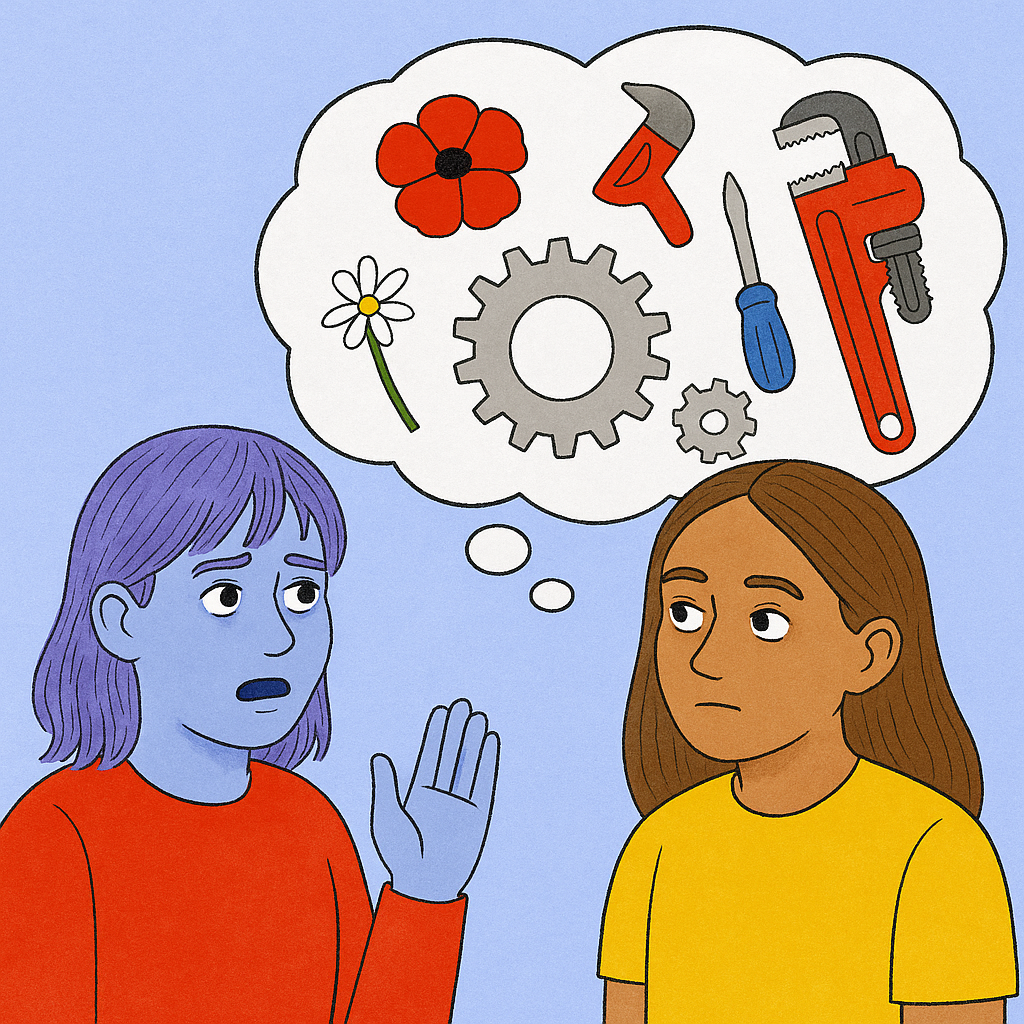
Your partner comes home after a tough day. They’re frustrated with their boss, exhausted, upset, or overwhelmed. You listen, and almost immediately, you see the solution. It’s clear as day. You offer it generously, lovingly, confidently. And somehow you both end up feeling….. further apart. Your partner feels dismissed, irritated, or deflated. You feel confused, maybe even unappreciated. After all, you were trying to help. Your intentions were good. Your idea was solid. So why does offering a solution so often make things worse?
What hermeneutics actually means
Hermeneutics is a big, intimidating word for something we all do constantly: It’s all about: how we make meaning, how our words shape how we experience each other and how every response gets interpreted, whether we mean it to or not
In other words, we're never just talking.
We’re always sending signals about what matters, who we are, and how we see each other.
What offering a solution does (even when you mean well)
If we look at the scenario above, not through intention but through impact some patterns show up.
Solutions stop the emotional conversation
Not intentionally. Not maliciously. Just structurally. Solutions move the conversation out of the emotional and relational world and into the world of fixing, planning and doing . The unspoken message becomes “This is a problem to solve, not an experience to sit with.”Solutions skip over the deeper meaning
This is why I call it intellectual bypassing. Instead of staying with your partner’s frustration, hurt, fear, or need for support, the conversation moves into thinking mode where things may feel safer and more manageable,Solutions accidentally put you in the “expert” role
Again, not intentionally, but relationally, it sets up a hierarchy. It communicates “I see things more clearly than you” or “You’re stuck; I’m here to unstick you.”
And here’s the key hermeneutic insight:
What we do in these moments reveals how we understand the relationship.
It reveals how you see yourself, how you see your partner, and what world you believe you’re both living in.
Questions That Change How You Show Up in Relationship
This kind of work isn’t about blaming yourself or doing things “wrong.” It’s about curiosity—especially in the moments where you instinctively jump into problem-solving mode. These questions help slow things down and bring awareness to what’s really driving the urge to fix.
What understanding of myself is already at work when I respond with solutions? Do I see myself as responsible for fixing things? As the steady one? As the one who needs to make the discomfort go away?
What understanding of my partner shapes why I respond this way? Do I assume they can’t handle their feelings? Do I assume they want advice rather than connection? Do I assume their emotions are problems to be minimized?
What prior meanings make dialogue feel risky or unnecessary?Growing up, was talking about feelings unsafe> Did conflict get solved with logic instead of presence?Did you learn that competence equals love?
What “world” am I projecting when I offer solutions instead of presence? A world where emotions need to be controlled? A world where intimacy is built through fixing, not sharing? A world where vulnerability is something to move through quickly?
What interpretation of the moment is already running the show?Do I interpret my partner’s distress as failure? As criticism of me? As something I must repair?
Why This Matters in Couples Therapy and Relationships
In couples therapy, one of the biggest shifts happens when partners realize that every interaction carries meaning. We’re not just reacting to each other, we're constantly showing how we understand the relationship, ourselves, and each other’s emotions.
When couples don’t see this, conversations often sound like: “Why are you always trying to fix me?”
But when this pattern becomes clear, the dialogue changes:“When you offer solutions, It feels like you’re not really with me and my feelings.” or “ When I see you’re hurting, I feel like its my job to fix it”
This is where real emotional connection begins. Instead of blame, couples develop curiosity. Instead of defensiveness, they build understanding. Instead of fixing or withdrawing, they learn how to stay emotionally present with each other.
Intellectual Bypassing Relates to the Individual
All of this has been geared toward couples, but it can just as easily be applied to you as an individual. So often people tend to intellectualize their problems, reframing their thoughts, finding a solution, analyzing what happened…. which are all helpful tools. But often, the experiential piece gets skipped: feel the feelings.
If you have a bad day at work, give yourself permission to feel that emotion for a period of time. If someone disappoints you, let your body experience that disappointment, sense the knot in your stomach, or the heat in your chest as anger comes up. Feel the feelings! Breathe through it! Cry through it! Experience it.
And then use all the wonderful tools in your toolbox to address it.
Of course, for a lot of people sitting with feelings can be easier said than done which is why intellectual bypassing can feel like such a safe place to land. But this is where the deeper work lives and where the nervous system, both for you as an individual and within a relationship, really comes into play.
Take the Next Step Toward Healing
If you’re curious about feeling all the feelings I invite you to reach out for a consultation. Sometimes, the first step toward getting unstuck is simply allowing yourself to imagine that change is possible.
-Written by Matt Nitzberg