The Feedback Wheel in Relational Life Therapy: How to Have Difficult Conversations Without Getting Stuck
Every couple has difficult conversations.
Maybe one partner feels like they are carrying too much of the household responsibility. Maybe someone feels dismissed during arguments, disconnected during sex, or frustrated by how decisions are made. Often, the issue itself isn't what causes the most damage.
It's how couples talk about the issue.
A conversation that starts with, “Can we talk about what happened?” can quickly become:
“You never listen to me.”
“That's not what happened.”
“You're always criticizing me.”
“Well, you do the exact same thing.”
Before long, the original issue has disappeared underneath defensiveness, blame, and counterarguments.
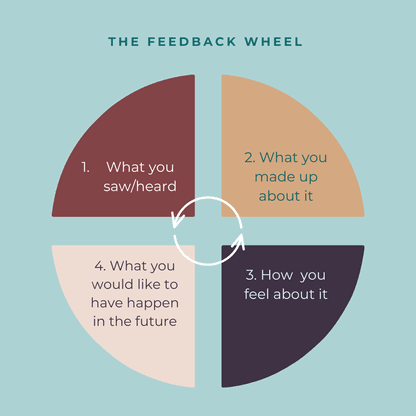
In Relational Life Therapy (RLT), feedback is an important tool for interrupting this cycle. The Feedback Wheel provides couples with a structured way to talk about difficult experiences while staying connected to what actually matters: what happened, how it affected you, what it is doing to the relationship, and what needs to change.
Why Couples Fight About Money
In Relational Life Therapy (RLT), we focus less on who's "right" and more on whether the conversation is protecting the relationship.
That's a significant shift. Instead of trying to win the argument, the goal becomes understanding each other's experience and creating a financial plan that works for both partners.
One of Terry Real's core principles is relational accountability. It's not enough to be factually correct if your behavior is damaging the partnership. Likewise, respect doesn't become optional simply because you're stressed. Healthy relationships move away from blame and toward collaboration.
Why Feedback Can Be So Difficult for Couples
Giving feedback sounds simple: “I didn't like what happened, and here's why.”
But in an intimate relationship, feedback can feel threatening. When your partner tells you that something you did hurt them, it can be easy to hear the message as: “You are a bad partner.” Instead of: “Something happened between us that we need to understand and work on.”
The person receiving feedback may become defensive, explain their intentions, point out what their partner did wrong, or shut down completely. The person giving feedback may then become louder, more critical, or more insistent that their partner understand their perspective.
This creates a familiar relational cycle:
One partner pursues → the other becomes defensive → the first partner escalates → the other withdraws → both partners feel misunderstood.
The Feedback Wheel slows this process down. It helps couples move away from proving who is right and toward understanding what is happening between them.
What Is the Feedback Wheel?
The Feedback Wheel is a framework for giving feedback in a way that is specific, relational, and actionable. Instead of starting with a global criticism like: “You don't care about me.”
The Feedback Wheel helps you slow the conversation down and move through six steps:
What happened?
How did it affect me?
How is it affecting us?
What do I need?
What am I asking for?
Can we check in with each other?
The goal isn't to prove who is right. It's to communicate clearly enough that your partner can actually hear you.
1. Observation: What Actually Happened?
Start with the facts: Separate what you actually observed from your interpretation of what your partner's behavior meant. Instead of: “You completely ignored me last night. Try: “When I was telling you about my day, you looked at your phone several times and didn't respond.”
Keep in mind:
Focus on what you saw or heard.
Avoid assumptions about your partner's intentions.
Avoid words like “always,” “never,” or “completely.”
Describe the behavior rather than labeling the person.
Ask yourself: “Could a camera have captured what I'm describing?”
“You ignored me” is an interpretation.
“You looked at your phone several times while I was talking” is an observation.
2. Impact on You: How Did It Affect You?
Next, describe your experience. Ask yourself:
What did I feel?
What did this bring up for me?
What story did I start telling myself?
How did I respond internally or behaviorally?
You might say:
“I felt dismissed and unimportant.”
“I felt lonely.”
“I became anxious and started wondering whether what I was saying mattered to you.”
Try to take ownership of your experience: Instead of: “You made me feel unimportant.” Try:“I felt unimportant when that happened.” This isn't about minimizing the impact your partner had on you. It's about communicating your experience without assuming you know what was happening inside your partner.
3. Impact on Us: How Is This Affecting the Relationship?
Now zoom out from yourself to the relationship. Ask:
What is this pattern doing to us?
How does my reaction affect my partner?
How does my partner's reaction affect me?
What happens between us when this keeps occurring?
Are we becoming more connected or more disconnected?
For example:
“When this happens, I start pulling away from you.”
“When I don't feel heard, I become more critical, and then you tend to shut down.”
“We're spending more time arguing about whether I'm justified in being upset than actually resolving the issue.”
This step shifts the conversation from: “You hurt me.” Toward: “This is the pattern we're creating together, and I don't want us to stay here.”
4. What Do You Need?
Once you've identified the problem, get clear about what you actually need.
You might need:
More communication
More affection
More reliability
More emotional responsiveness
More shared responsibility
More transparency
More space
More reassurance
A different way of handling conflict
More time together
Try to make your need specific. Instead of: “I need you to care more.” Try: “I need us to spend 20 minutes talking without our phones after dinner a few nights a week.” A useful question to ask yourself is: “If my partner understood what I needed, what would I want them to do differently?”
5. Make a Request
Turn your need into a specific, behavioral request. Feedback tells your partner what is happening. A request tells them what you want them to do differently. A good request is:
Specific
Behavioral
Realistic
Clear
Something your partner can actually choose to do
Instead of: “I need you to be more supportive.” Try: “When I'm talking about something difficult, I'd like you to put your phone down and ask me one question before offering advice.”
The more concrete the request, the easier it is for both partners to understand what change actually looks like.
6. Check In: Give Your Partner a Chance to Respond
The Feedback Wheel isn't a speech.
After you've shared your experience and made your request, give your partner space to respond. You might ask:
“Can you tell me what you heard me say?”
“Does that make sense?”
“How is that landing for you?”
“Is there anything you want me to understand?”
“What are you noticing right now?”
Remember:
Your partner doesn't have to immediately agree.
Understanding is not the same thing as agreement.
Your partner may have a different perspective.
You may need more than one conversation to work through the issue.
Sometimes a productive response is simply: “I can understand why that hurt you. I didn't realize that's how it was affecting you.” That kind of understanding can be an important first step toward change.
The Feedback Wheel at a Glance
1. Observation:
What actually happened?
2. Impact on Me:
How did it affect me?
3. Impact on Us:
What is this doing to our relationship?
4. Need:
What do I need moving forward?
5. Request:
What specifically am I asking my partner to do differently?
6. Check In:
What did my partner hear, and what is their experience?
The Feedback Wheel Isn't About Being Perfect
One of the biggest misconceptions about communication tools is that if you use the "right" words, your partner will respond perfectly. Relationships don't work that way. You can communicate thoughtfully and still encounter defensiveness, hurt, disagreement, or misunderstanding. The Feedback Wheel isn't designed to eliminate conflict. It's designed to help couples do conflict differently. You may still be angry. You may still disagree. You may still need to have a difficult conversation. But instead of: “You always do this.” you can move toward: “When this happened, this was the impact on me, this is what it's doing to us, and here's what I'm asking for going forward.” That creates a very different kind of conversation.
Feedback Is Different From Criticism
There is an important distinction between feedback and criticism. Criticism tends to focus on the person's character:
“You're selfish.”
“You're impossible to talk to.”
“You don't care about anyone but yourself.”
Feedback focuses on behavior, impact, and change:
“When you walked away while I was talking, I felt dismissed. I notice that when this happens, I become more reactive and we end up further apart. I'd like you to tell me if you need a break instead of leaving without saying anything.”
The second approach doesn't mean softening the truth. In fact, it can require more honesty. You're still saying: “This behavior is hurting me and affecting our relationship.” You're simply communicating it in a way that gives the other person something they can actually respond to.
The Goal Isn't to Win
One of the most important principles behind effective relational feedback is that the goal isn't to establish who is right. Couples can spend hours arguing over questions like:
“Did you actually say that?”
“Who started it?”
“Who was more upset?”
“Whose version of the story is accurate?”
Sometimes those questions matter. But often, getting stuck in them prevents couples from addressing the larger issue. The more useful questions may be:
What happened?
What was the impact?
What pattern are we creating?
What do we need to do differently?
The goal isn't to erase differences in perspective. It's to create enough understanding that both partners can participate in changing the pattern.
Practicing the Feedback Wheel
The next time you and your partner are having a difficult conversation, try slowing it down. Ask yourself:
Observation:
What actually happened? Can I describe it without judgment or interpretation?
Impact on me:
What did I feel? What did this bring up for me?
Impact on us:
How is this affecting our connection or the pattern between us?
Need:
What do I need moving forward?
Request:
What specific behavior am I asking my partner to change?
Check-in:
Can my partner tell me what they heard? What is their experience?
You don't have to get every step perfect. The practice itself can help create a pause between feeling hurt and reacting from that hurt. And that pause can be where something different becomes possible.
When Couples Get Stuck
Sometimes couples know exactly what they want to say but cannot seem to have the conversation without falling into the same cycle. One person becomes defensive. The other becomes more insistent. Someone shuts down. Someone pursues harder. Both people leave the conversation feeling alone. When these patterns become entrenched, working with a couples therapist can provide a structured space to slow the cycle down and understand what is happening underneath it. Relational Life Therapy offers one framework for helping couples become more aware of their relational patterns, communicate more directly, and take greater responsibility for how they participate in the relationship. The goal isn't a relationship without conflict. It's a relationship where difficult moments can become opportunities for honesty, accountability, repair, and deeper connection.
Frequently Asked Questions About the Feedback Wheel
What is the Feedback Wheel in Relational Life Therapy?
The Feedback Wheel is a framework used in Relational Life Therapy (RLT) to help couples communicate difficult feelings and concerns more effectively. It guides partners through identifying what happened, how it affected them, how it is affecting the relationship, what they need, and what they are requesting from their partner.
How is the Feedback Wheel different from criticism?
Criticism often focuses on a person's character, such as “You're selfish” or “You never listen.” The Feedback Wheel focuses on specific behaviors, their impact, and what needs to change. Instead of labeling your partner, you can describe what happened, explain how it affected you, and make a clear request for what you'd like to happen differently.
What if my partner becomes defensive when I give feedback?
Defensiveness is common during difficult conversations, especially when feedback feels like criticism or an attack. The Feedback Wheel can help by keeping the conversation focused on specific behaviors and your own experience rather than your partner's character or intentions. It can also help to slow the conversation down and give your partner an opportunity to share what they heard and how the feedback is landing for them.
Does giving feedback mean my partner has to agree with me?
No. The goal of the Feedback Wheel isn't to convince your partner that your version of events is the only correct one. Healthy communication allows both partners to have different perspectives. The goal is to create enough understanding that you can recognize the impact of what happened and work together toward a different pattern..
How do I make a good request using the Feedback Wheel?
A helpful request is specific, realistic, and focused on a behavior your partner can actually change. Instead of saying, “I need you to be more supportive,” you might say, “When I'm talking about something difficult, I'd like you to put your phone down and ask me a question before offering advice.” The more concrete the request, the easier it is for both partners to understand what change looks like.
Can the Feedback Wheel help couples stop having the same arguments?
It can help couples recognize the patterns that keep recurring during conflict. Instead of getting stuck arguing about who is right, couples can look at what happened, how each person responded, and what the interaction is doing to the relationship. With practice, this can create more opportunities for accountability, repair, and connection.
Can couples therapy help us learn how to use the Feedback Wheel?
Yes. A couples therapist can help partners practice giving and receiving feedback while identifying the relational patterns that make difficult conversations challenging. In therapy, couples can learn how to communicate more directly, listen without immediately becoming defensive, and turn recurring conflict into opportunities for greater understanding and connection.
Couples Therapy in NYS
At Mindful Self Therapy, we work with couples who feel stuck in patterns of distance, conflict, shutdown, resentment, or miscommunication. Many couples come in worried that something is fundamentally broken in the relationship. Often, what’s actually happened is that both people stopped feeling emotionally reachable to each other. Couples therapy can help slow things down, make those patterns visible, and create new ways of connecting that feel safer and more genuine.
If you're in New York City, Brooklyn, or anywhere in New York State and keep having the same fight about money, couples therapy can help you improve financial communication, break unhealthy relationship patterns, and work together as a team instead of opponents. Reach out to schedule a free consultation.